
21st Century Ent | Dream Dancer | Woodland Songster | Pied Piper | Child Whisperer |
Sharifa Oppenheimer
A native of the vast, flat midwestern prairie, I was born and raised in 1950s Kansas – the very middle of middle America – during a pivotal shift in American life when television was new, plastics were becoming mass-produced, and the atomic bomb had recently been used in warfare. A fish out of water even at a young age, I was always happier reading a book beneath my favorite tree than sitting in front of a screen. In the summer I would gather fireflies in a jar and try to read beneath the sheets when lights were out. My two girlhood best friends were books and nature. To read a book while surrounded by the green world of my back yard was a potent child’s prayer.
This love of the written word and the wordless languages of nature have remained essential threads in the fabric of my life. So, as you would imagine, the opportunity to join Sandie and the No BS Spiritual Book Club is a joy! Choosing the ten most influential spiritual books of my life has been a time-travel journey. As I re-explore each book, I remember viscerally, emotionally and cognitively my exact place and mood when I first encountered it. Rereading these favorites so many years later, I can remember the powerful Aha! moments I experienced. I also uncover layers of meaning I missed at a younger age. Current books, as well as my classic favorites, have joined this list, and I imagine new favorites will always appear, as I continue to read, while listening to the voices of the Book of Nature.

SHARIFA OPPENHEIMER is the author of the best-selling book Heaven on Earth: A Handbook for Parents of Young Children and its companion workbook How To Create The Star of your Family Culture. Her recently released book With Stars in Their Eyes: Brain Science and Your Child’s Journey Toward the Self offers traditional wisdom-ways alongside the cutting-edge research in brain science that supports this gentle way of fostering the finest brain development.
After writing extensively from her experience, wisdom, and love of young children, she has turned toward writing about other aspects of profound connection. She offers Sacred Earth ~ Sacred Self gatherings that explore humanity’s biological and spiritual inter-being with our other-than-human relations. Her new book A Litany of Wild Graces: Meditations on Sacred Ecology explores these themes through essays, poetry, and litany. Sharifa is the mother of three grown sons, who were educated in the Waldorf tradition. She lives with her husband in an enchanted forest in Virginia. | https://www.sharifaoppenheimer.org/about
My 10 Best
(in no particular order)

Seven Arrows
by Hyemeyohsts Storm
Seven Arrows is the book I “fell awake” to. Having been born into the sterile conformity of the 1950s American Dream, and lived the tumult of the 1960s, this book showed me a way of being that has evolved from the organic cycles, balances and sacredness of life itself. In it I discovered the Medicine Wheel of the Plains Indians, a simple pattern portrayed with stones laid out on the earth. Through Seven Arrows, this unpretentious icon opened my understanding of the vast interconnecting worlds of relationships and responsibilities. These relational patterns, represented by images and colors, open into infinite connections within the community of all living beings as well as within oneself.
In this book we are shown both the beauty and the brutality that different world-views foster within human beings. America’s original peoples’ lives were structured on principles of sacred relationship: the generosity of the abundant earth, a sense of reciprocity and gratitude, respect for the personhood and agency of not just the plants and animals but all landforms, waters and winds that made their human lives possible. The people’s incomprehension of the European worldview of conquest, domination and exploitation of lands, peoples and all beings aches palpably throughout the pages. Yet the unwavering bond with Mother Earth was never broken and perseveres today.
Universal wisdom is held within the book’s many teaching stories. Particularly potent for me was the story of Jumping Mouse. Through listening inwardly, Jumping Mouse begins a journey in which he is challenged beyond measure, meets unexpected allies, is tempted to abandon his quest mid-way, and yet with both grace and grit, his transformation is fulfilled beyond imagination. The aliveness of this profoundly relational world view set me on a life path that I continue to explore these many years later. Fifty years after its publication Seven Arrows is alive and well, continuing to teach.
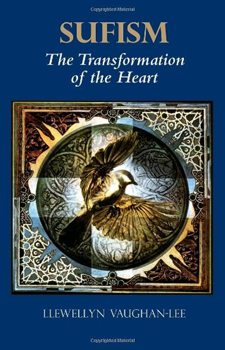
Sufism: The Transformation of the Heart by Llewellyn Vaughan-Lee
In this book Llewellyn Vaughan-Lee offers a clear, complete and concise introduction to the evolution, principles and practices of the Sufi path, with its many branches as well as its unifying principle of Oneness.. He takes the reader on a journey into the mystery of the soul’s longing for Spirit ~ longing as a feminine aspect of love ~ and portrays dreamwork as a receptive art of listening. It is in dreamwork that we discover the great archetypes which form the riverbeds of human consciousness, which can arrive in dreams as symbols and teachers. Dreamwork within a spiritual group also offers the student a great protection: with the support of the group, one is less vulnerable to the ego inflations some dreams and practices can trigger.
Llewellyn lays out the profoundly embodied spirituality of Sufism, with sacred breath as the light by which the seeker navigates. Sufis have practiced the mystical science of breath for millennia, while engaged in the ordinariness of daily life, including family, work and community. He describes the process of “bringing the opposites together within the heart,” marrying the mystical transformation of spiritual practice with the present-moment reality of one’s own everyday life.
As a working mother juggling the subtleties of a blended family, this ancient path of transformation suited me well. Because I was a Waldorf Kindergarten teacher, as well as the mother of three sweet and rowdy boys, it was joyful to bring the Sufi’s science of embodied presence through the breath into the many hours that I lived, each day teaching and mothering young children. Llewellyn’s Sufism: the Transformation of the Heart and his The Paradoxes of Love were the “user’s manuals” that accompanied me and served me well through the years.
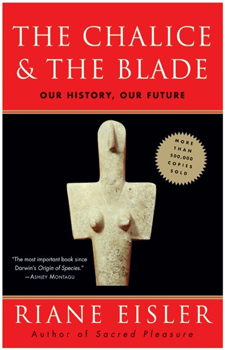
The Chalice and the Blade
by Riane Eisler
In this ground-breaking book, systems scientist and author, Eisler takes the reader on a journey through human history with a lens that examines anthropology more deeply than tribalism, feudalism, capitalism or communism. She coined the terms “partnership” and “dominator” to describe the two fundamental forms of society. Partnership, or linking societies are based on gender equality, the arts of caring and creativity as well as peaceful conflict resolution. These societal qualities create stability and sustainability. For millennia partnership was the principle form of human interaction. “Dominator,” or ranking societies, are characterized by sexism, chronic war, violence within the social structure and ecological destruction. They are, eventually, unsustainable. Using a systems approach, the author establishes the external factors that radically destabilized these early partnership societies, which flourished in Neolithic Old Europe, as well as the Middle East. She also traces in various societies the fluctuating resurgence of the partnership model, intermittently breaking through the culture of dominance.
Riane Eisler sees the current era as the death throes of five thousand years of domination. This is evidenced in world-wide partnership movements, for instance the education of girls and women, the ecological sustainability movement, a shift away from authoritarian religions and toward an open “spirituality.” This is also visible in some nations’ hard swing toward the right politically ~ fiercely clinging to the dominator mode. The best news is that Ms Eisler does not abandon us to these cerebral and theoretical matters. Her companion book “The Partnership Way” is a handbook that helps to usher in the new and ancient paradigm: The Chalice, not The Blade. At this time of crisis, as the dominator mode becomes visibly destabilized, humanity is again presented with the opportunity to choose linking and partnership as the path into a thriving future for all beings. Riane Eisler’s work points us toward return.
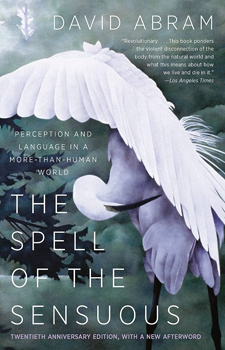
The Spell of the Sensuous
by David Abram
At the turn of the century my mind was turned upside-down in reading The Spell of the Sensuous. Here, I found David Abram speaking of the animate breathing earth in ways I had only experienced in dreams, in that liminal state when my western-trained rational mind was absent. Although ostensibly written about the evolution of perception and language, which one might expect to be a heady subject, the sense of the sacred permeates each redolent line. In David’s world, and in the primordial world to which he so vividly introduces the reader, the sacred and the sensuous are never divided. The scent of mystical honey arises from the page and calls to that knowing which lies below the technological mind’s radar yet permeates every cell of our being.
Although since childhood my life had been conducted in large part reveling in the natural world, it was at this invitation that I finally abandoned whole-sale the notion of a Divinity separate from the living body of earth herself ~ of Gaia. My feet began to grow roots and green tendrils twined with my hair. In a later book Becoming Animal, David says “An eternity we thought was elsewhere now calls out to us from every cleft in every stone, from every cloud and clump of dirt. To listen is to be turned inside out, discovering to our astonishment that the wholeness and holiness, the secret and sacred One we’ve been dreaming our way toward has been holding us all along, enfolding us in … unfathomable wholeness and complexity.” To recognize that this One is rainfall, garden soil, birdsong, lichen, July heat and every breath is a joyous liberation beyond any words the mind can conjure.
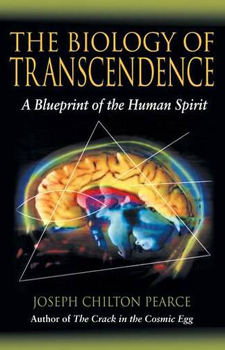
The Biology of Transcendence ~ A Blueprint of the Human Spirit by Joseph Chilton Pearce
It was in Joseph Chilton Pearce’s The Biology of Transcendence that my attentiveness to the marriage of science and spirit blossomed. In this groundbreaking book, Joe Pearce digs into the then new science of neonatal and early childhood brain development in ways that speak strongly to me as a teacher of young children. His carefully researched and revolutionary insight is this: human beings are hard-wired for experiences of transcendence ~ for Spirit, call it by any name. He examines in depth the neonate’s brain development as it moves through each trimester of pregnancy. He includes in this exploration the way the mother’s physical, emotional and mental state of being shapes and influences the child’s developing brain. For me, his most fruitful insight is in regard to the development of the prefrontal cortex, evolution’s most recent brain structure. It is here, in the PFC, that humanity’s highest qualities reside, those born of spirit and nurtured by love. Paul McLean, the late twentieth century brain researcher who discovered and explored this region of the brain, called it the Angel Lobes.
Pearce walks us through the societal mores, fostered by current educational methods and practiced in all realms of daily life, such as competition and ranking, that systematically impede the full flowering of this our most spiritual capacity. He also points the reader toward principles and practices that support rather than obstruct its unfolding. Knowing the fact that the prefrontal cortex is environment-and-experience dependent ~ it depends upon healthy modeling by the child’s parents and teachers ~ this has fleshed out more fully my life’s work with young children and their families. It is through our own heart-connection to spirit that we adults pass the light of this wisdom to our children.

Braiding Sweetgrass
by Robin Wall Kimmerer
As I read Braiding Sweetgrass it seemed that I sat in a circle of quiet people listening to spiritual wisdom that has been passed heart to heart for millennia. Robin Wall Kimmerer, member of the Citizen Potawatomi Nation and distinguished professor of Forest Biology, continues to hold the potency of her people’s original stories in the face of a narrow western scientific training. This is a testament to the life-affirming legacy of her people’s relationship with the living earth. She is a consummate story teller, weaving many threads with simple grace, like the roots of her beloved plants that weave together below the rich loam and hold the entire biome in health.
For instance, in a single chapter she shows us in exquisite detail the bounty offered by marsh plants. She and her students go “shopping” in the marsh, where they gather everything they need: they build their classroom and feast on cattail kebobs, roasted rhizomes, and pollen pancakes. Their bug bites are soothed by cattail gel, and they weave gathering-baskets from netted roots. With unflinching truth, yet without rancor, she shows us this intrinsic wholeness while also placing it side by side with the brutal poisoning by the “captains of industry” of Onondaga Lake and its entire watershed. Each story of the many tales she tells carry an essential message; they point toward the ruinous effects of humanity’s broken relationship with earth as well as essential ways of living in harmony toward a whole thriving future.
It was with Robin Kimmerer that I first encountered “two-eyed seeing.” In her simple and profound way she brings together what until recently have been seen as opposing forces, Indigenous Wisdom and Scientific Knowledge. She affirms that we cannot return to the past; rather, it is through the integration of these complementary ways of knowing that humanity will find its way through an uncharted future.
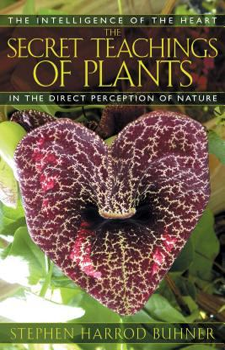
The Secret Teachings of Plants
by Stephen H. Buhner
For me, reading The Secret Teachings of Plants was a tutorial in ever more finely recognizing Spirit’s luminosity glowing through matter. This book is written in two parts; we could call them Science and Poetry. The first part, Systole ~ which is the active function of the heartbeat ~ is a glorious romp through the non-linearity of Nature. Here, using the knowledge of Holistic Sciences, Stephen Buhner thoroughly trounces Euclidean and Newtonian reductionist thought, as well as the domination, exploitation and extraction this human-centric view engenders. He offers an evolving understanding of the world of electromagnetic fields and the vastly sensitive capacity of all living organisms to understand and make relationship through this “language” of waves-fields. He re-introduces the human heart as a powerful organ of perception and communication, as its function for millennia was understood to be.
In the second part, Diastole ~ which is the resting function of the heartbeat ~ through poetry, musings and essay, he explores the ancient Human/Nature symbiosis. Recognizing the heart as a potent tool in the direct perception of nature, he draws the reader toward the participatory consciousness that flows between humanity and the vast intertwining holarchy of the natural world. Making relationship with plants, or with any other-than-human being, is tenderly compared to the many different ways we court and nurture relationships with our own complex and multifaceted species. In exquisite detail we learn to listen to the music of the Universe, in order to intuit the steps of the dance.
In The Secret Teachings of Plants, we discover Spirit sprouting up between words, vining around and between ideas, whispering through the branches of poems and always leaning close, hoping to be seen.
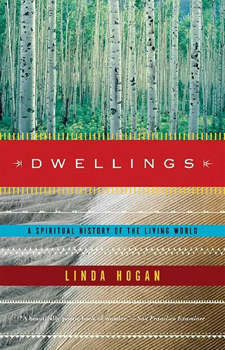
Dwellings: A Spiritual History of the World
by Linda Hogan
It is difficult to find adequate words to describe this collection, by Linda Hogan, writer, poet and Chickasaw Nation’s Writer-in -Residence. Not merely essays, these are also her love songs, her prayers to the infinite radiant beings that populate the breathing, sensing, earth. Her stories bring me into a world of intimate presence and tenderness. Telling in detail of her meetings with bats, she opens for me a new world of sound; I find myself navigating by sonar, flitting through blue evening air. A bald eagle feather survives a burning house. It now inhabits her dream and calls a living eagle, a spirit cousin, who gazes at her through the bedroom window. Her words are potent magic and I feel the wind lifting flight feathers. She instructs and returns me to an ancient understanding of the snake people. Before Snake became burdened by human sin, “it coiled beautifully and mysteriously around human imagination.” It was a symbol of healing and wholeness; the coiled snake taught of infinity “gone in a circle around itself.” She calls Wolf, Water, Porcupine, Corn ~ these close relations of hers ~ People. In her offering of this deep respect, my bones begin to understand that we humans are direct descendants of our other-than-human relatives. We owe them honor and gratitude. We owe them care as well, for this is our primordial covenant.
In Dwellings, as well as all of Linda Hogan’s work, her words are numinous messengers. They are arrows of light arcing from cosmic beginnings, bringing luminous knowledge into the densely armored darkness of the current crisis. The transformative magic she offers the reader is Hope.
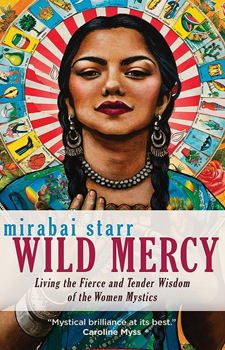
Wild Mercy
by Mirabai Starr
Mirabai Starr is a fresh and contemporary voice that rescues the spiritual life from its narrow cell of asceticism, from the principles and practices designed in previous centuries for monks, primarily men. Through the voices of the world’s women mystics Mirabai walks with us amid gardens of shimmering beauty, brings us to a table bountiful with ripe fruit and fresh baked bread. She shows us that the root of women’s spirituality has always been devotion and service to life itself. Through her eyes we see the holiness in embodiment, the holiness in our own everyday life.
Mirabai gazes with love into all the nooks and crannies, the shining glories and dark corners of human life. She brings a new dispensation to the wish for a contemplative life, assuring us that the Divine is woven into every detail. It is through embracing the lovely pandemonium, not ascending above and beyond the mess, that we bring love into a desperate world. She steps with us into the cycles of life, shining the light of compassion on those events that break us open and melt us down. She teaches us to recognize the divine in all arenas of life ~ in community and the web of interbeing, in the divine union of sexuality, in mothering as a path of awakening.
She offers a map of safe passage left by the footprints of the women mystics she studies, translates and emulates. Mirabai turns to these ancient mystics in order to shine a light on the holy details of a complex twenty-first century life. She also helps us contemplate ~ without terror or anger, without denial or paralysis ~ the existential crisis we now face. She gives us real-world examples in the path of prayer-filled action. This path has always led directly into the heart of the world, and its embodied wisdom shimmers from each page.
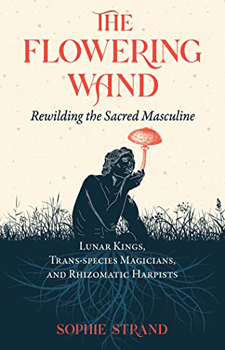
The Flowering Wand: Rewilding the Sacred Masculine by Sophie Strand
Patriarchy as we know it gets a thorough shaking out in the learned and light-hearted prose of Sophie Strand. Though not shy to storm the ponderous edifice, Sophie Strand avoids “the master’s tools:” no cannons or catapults here. Rather, Sophie calls her beloved mycorrhizal and cyanobacterial kin to the task. With her pen in hand and experts in decomposition by her side, together they dig below the stone-walled, straight-jacketed patriarchal fortress which has imprisoned men and women for centuries.
She introduces us to the thyrus, the ancient flowering wand carried by Orpheus and Dionysus. When touched by the thyrus we may be catalyzed into mystical exultation or shape-shifted into an animal or plant. When Orpheus carried the thyrus, his musical ecstasy charmed the animals of the forest and even the trees bent closer to hear his sublime singing. This vegetal wand accompanied kings and healers for millennia, drawing a circle of protection around a woman in labor or healing a child near death. It was also used to spread fertility through the fields, to bless weddings and send the dying on a successful journey through the other worlds. The thyrus was a living entity that created abundance, connection and thriving.
The sword, on the other hand, slices, divides and conquers, making every interaction about conflict and every story about domination and exploitation. Why have we chosen to place the sword in every boy’s hand, and how do we go about replacing it with its most ancient predecessor, the thyrus? Sophie Strand affirms that we can dismantle the master’s house, and with the ancient tools of Story. With urgency and humor, prophecy and whimsy, she retells the hero’s journey, the grail myth, the Merlin tales, the biblical stories of David and Jesus, and many more. The green pawprints of nature accompany her shape-shifting words across every page.