
Eternal student | Watcher of the skies | Inner explorer | Musician and swimmer | Cultural historian | Archetypal cosmologist | A work in progress |
Richard Tarnas
Selecting the ten books that were personally most transformative—spiritually, psychologically, intellectually—has been both a joyful and a challenging task. Joyful, because just contemplating the many books that have enriched and transformed my life brings forth a renewed sense of gratitude for all those works and authors, along with a sense of awe at the extraordinary treasures they have left us. But challenging, because it is so hard to whittle the list down to just ten. I’m sure most of us who have participated in this exercise have felt a similar combination of difficulty and enjoyment.
In the end, the only way I could find my way to a final list was to leave out certain categories. For example, though I have drunk deeply and gratefully from the springs of Asian mystical wisdom, I have focused my choices here on the Western cultural tradition, that within which I have been most embedded and educated. Even then, I have not included those masters of Western esoteric insight, like Rudolf Steiner and Dane Rudhyar, from whom I have learned so much. Of the many novels that have affected and no doubt shaped me beyond my awareness, I have decided to offer the two most consequential, but it was difficult to leave out so many others. I did not include ancient and Renaissance classics such as the Odyssey, the Symposium, or the endlessly astonishing plays of Shakespeare. I decided to leave out certain books that were important in my own life but might not necessarily speak to the wider range of sensibilities of those who would peruse these Ten Best lists, unique works like James Agee’s Let Us Now Praise Famous Men or Alan Watts’s Beyond Theology. Finally, I have reluctantly left off from my list the brilliant books of my closest professorial friends and colleagues, several of which have deeply informed my vision; otherwise, I would have no room for those works coming from outside that beloved circle of kindred spirits to whom I am so indebted.
All that being said, I hope the final list below, distilled out of many noble candidates, will be of interest and perhaps personal value to others.
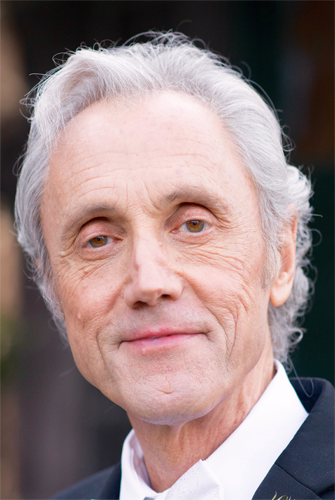
RICHARD TARNAS, PhD, is Professor Emeritus at the California Institute of Integral Studies in San Francisco, where he founded the graduate program in Philosophy, Cosmology, and Consciousness. He has taught courses in the history of ideas, depth psychology, archetypal cosmology, cultural history, and the evolution of consciousness. He has also frequently lectured on archetypal studies and depth psychology at Pacifica Graduate Institute in Santa Barbara, and was formerly the director of programs and education at Esalen Institute in Big Sur. He is the author of The Passion of the Western Mind, a narrative history of the Western world view from the ancient Greek to the postmodern that is widely used in universities. His second book, Cosmos and Psyche, received the Book of the Year Prize from the Scientific and Medical Network. He is a past president of the International Transpersonal Association and member of the Board of Governors for the C. G. Jung Institute of San Francisco. | https://cosmosandpsyche.com/
My 10 Best
War and Peace
by Leo Tolstoy
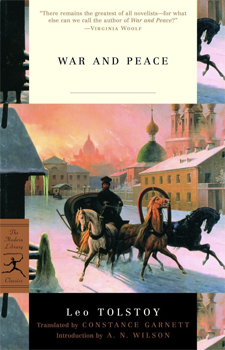
War and Peace is the first book that has always come to mind when I’ve been asked what I considered to be the greatest works that have influenced my life. I’m sure I am not alone in that regard. The book seems to have been written by Life itself. Tolstoy was somehow able to enter deeply into the life experience of the entire spectrum of humanity, young and old, aristocrat and peasant, male and female, able to portray a young girl’s first falling in love or a despairing soldier’s dying on the battlefield, a shallow social climber’s calculations or a lifelong spiritual seeker’s sudden revelation. His breadth of human sympathy is truly Shakespearean. Great novelists of the 19th century like Flaubert and Turgenev read the early installments of the book circulating in Europe with amazement at how richly Tolstoy was able to convey an entire panorama of life and humanity. He is a titan of world literature, like Beethoven in music or Michelangelo in painting and sculpture.
I was fifteen when I first read War and Peace, and had read it several times by my early twenties. I ended up reading everything Tolstoy wrote, from his early works Childhood, Boyhood, and Youth, through his other great novel Anna Karenina and on to his important novella The Death of Ivan Ilyich, his later religious and utopian essays, and, with special appreciation, his short Russian folk tales like “God Sees the Truth But Waits” and “How Much Land Does a Man Need?” Along with Dostoevsky, the author who follows on my list here, Tolstoy greatly deepened my sense of the spiritual significance of life and death at a time when I was making my way through the usual youthful journey of existentialist questioning and seeking.

The Brothers Karamazov
by Fyodor Dostoevsky
The Brothers Karamazov is Dostoevsky’s final masterpiece, finished just months before he died. Like War and Peace, the book portrays the encompassing breadth of human life and personality in a narrative of epic proportions. It is always striking to me how certain creative infusions into human culture can emerge simultaneously from several artists or scientists or philosophers within the same nation and generation, like the High Renaissance triumvirate of supreme artists in Italy, the brilliant circle of German philosophers in Jena at the turn of the nineteenth century, the Black American geniuses of jazz from New Orleans, Chicago, and Harlem in the 1920s and ‘30s, or the wave of British rock musicians from Liverpool and London during the 1960s. The fact that Russia in the mid-nineteenth century produced both Dostoevsky and Tolstoy, the two novelists most often singled out as great, even supreme, is a testament to this remarkable tendency in cultural history. Both authors plumbed the deep questions of human life and expanded our culture’s moral sensibility. Both depicted richly human characters in sustained, interweaving dramatic narratives. But where Tolstoy captures the broad human drama of ordinary human beings facing the wide range of life’s vicissitudes, Dostoevsky penetrates to the psychological depths of intense, fraught men and women in extremis, confronting the great existential realities, and sometimes undergoing deep moral and spiritual transformations. One can easily see how Dostoevsky paved the way for Nietzsche, for Freud and Kafka, for Camus, even for the array of great films of Ingmar Bergman like The Seventh Seal and Wild Strawberries.
It was actually Dostoevsky’s earlier masterpiece Crime and Punishment that I first read and was deeply affected by at age seventeen. Urged by my father (who was not very pleased to find the complete collection of James Bond paperback novels in my bedroom) to seek out great world literature, I had joined an “International Collectors Library” book club out of my teen-age earnings. I was able to purchase by mail both Tolstoy’s and Dostoevsky’s novels in a reasonably priced but gold-leafed leather-bound edition that looked a little like holy scripture, with a sewn-in ribbon to mark one’s page. An unexpected side effect of this elegant format was that I was able to sneak Crime and Punishment into the chapel during my Jesuit retreats and read it there for hours tucked inside a church missal while appearing to be meditating inwardly on the state of my soul—both of which I sincerely felt to be the same activity. As with Tolstoy, that first encounter led me to read everything Dostoevsky wrote, from his early works like Notes from Underground and The House of the Dead through to his other mature novels The Idiot and The Possessed. Plus we have his wonderfully moving letters, like those written around the time of his arrest by czarist police for his political activism, followed by a death sentence, sudden reprieve, and ten-year exile to a Siberian prison camp and compulsory military service. Many literary scholars and authors have argued about who was the greatest, “Tolstoy or Dostoevsky,” but as one literary scholar put it, “There really is no competition on Parnassus. . . . They are both great writers and now live in a realm beyond competition.”
Thus Spoke Zarathustra
by Friedrich Nietzsche
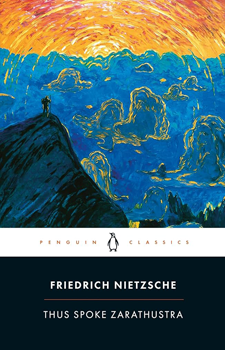
Nietzsche is brilliant, complex, even overpowering. One must read him with care. He is in certain respects the most powerful intelligence of the nineteenth century who most influenced the twentieth, initiating the gradual transition from the modern to the postmodern. There is nothing quite like Thus Spoke Zarathustra in world literature. It is sublime and compelling, written in a state of high inspiration. At times in his life Nietzsche appears to be debating and even carrying the cultural evolution of an entire civilization within him. His writing is driven by an elemental force of nature and spirit that seems to transcend even his own capacity to comprehend what is coming through him. He was a vessel of more than he knew, and it is requiring the work of many others since his death to discern and unfold what erupted in his soul.
I sometimes think of certain key works as forming a canon of dark gospels for a post-biblical age. These works read as if they were written at midnight on a mountaintop during a thunderstorm, the pages illuminated by lightning—Nietzsche’s Zarathustra, Blake’s Marriage of Heaven and Hell, Melville’s Moby Dick, Jung’s Answer to Job. I read Zarathustra during my last week at university before graduation, alone in my upper-floor room in Cambridge, Mass. after I’d finished my final semester’s exams and papers, at the start of a new stage in my spiritual journey after all the years of formal education. I am not certain what drew me to it at that moment, but as often happens, it was the right book at the right time. Reading it felt like having the top of my head suddenly opened up and my spirit lifted at high speed to dizzying heights, taking my breath away by its sheer intensity, courage, boldness, the elevation of its vision and beauty of its language. Nietzsche wrote Zarathustra during the ten years after he left his position as a young professor of classical philology in Basel to wander the Swiss Alps each summer. There he gestated his ideas in vigorous interior dialogue, then composed his books during the winters in rented rooms in coastal Italy and France. We’re still absorbing the fertile results. I recommend the muscular, poetic translation by R. J. Hollingdale, published by Penguin. That edition contains Hollingdale’s superb introduction which situates Zarathustra within the context of Nietzsche’s personal life and philosophical development. I would urge that one read Nietzsche’s text first, and only then read the insightful introduction. That way, Nietzsche speaks more directly as he intended, rather than already situated and interpreted. He lived in his writings and is fully embodied there—the rest of his existence was preparation, background, counterpoint, foil, but in his books he soars with unprecedented insights, creative joy, amor fati, the unconditional embrace of life and death.
A Room of One’s Own
by Virginia Woolf
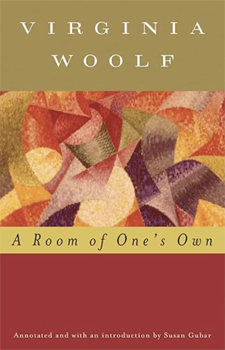
In October 1928, Virginia Woolf delivered two lectures to women students at the University of Cambridge that eloquently set forth what it is to be a woman of artistic gifts and intelligence living within the intolerable yet unbending constraints and prejudices of a patriarchal world. She published these as an extended essay the following year. It is an unforgettable cri de coeur and cultural intervention. The work has rightly taken its place as a crucial milestone in the history of feminist literature. Sixty years later, it was adapted into an extraordinary one-woman play with Eileen Atkins (now available for free streaming on YouTube). Atkins brings to vivid expression the full force of Woolf’s personality and cultural authority. It is a memorable performance.
As with each of my ten selections, I have cited A Room of One’s Own not only as a great work in itself but also as a paradigm instance of a longer lineage of works that have also been critical to my formation. Mary Wollstonecraft’s foundational Vindication of the Rights of Woman is the earliest essay in this lineage, while the important works of contemporary feminist thinkers such as Catherine Keller’s From a Broken Web, Carolyn Merchant’s Death of Nature, Evelyn Fox Keller’s Gender and Science, Anne Baring and Jules Cashford’s The Myth of the Goddess, and Charlene Spretnak’s Resurgence of the Real have continued to develop the feminist vision as it illuminates history, psychology, philosophy, mythology, and deep ecology.
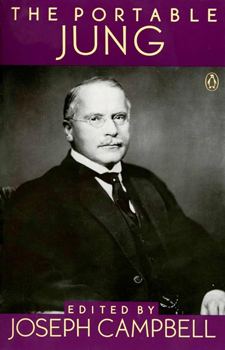
The Portable Jung
edited by Joseph Campbell
It is difficult to choose just one essential book out of Jung’s many works available in English, let alone German, including the 20-volume Collected Works and the autobiographical Memories, Dreams, Reflections. Fortunately, Joseph Campbell performed a great service in making an informed selection of Jung’s writings extending throughout his life, from the early foundational works on archetypes to the irreplaceable works he brought forth in his later seventies and early eighties, such as his final lecture at Eranos, “On Synchronicity.” Also included at the end is Jung’s most revolutionary and still prophetic Answer to Job—a revelatory work written in a white heat of inspiration, the only work of which he said he would not change a word. (As a friend of mine said of Answer to Job, “This will, I believe, be on the final.”) Campbell introduces the volume with an excellent biographical overview of Jung’s life and development.
“We live in a post-Jungian world,” as Dean Alan Jones once pointed out, where such ideas as the collective psyche, archetypes and complexes, introversion and extraversion, and synchronicity have fully entered into the contemporary vocabulary and sensibility. Above all, there is Jung’s recognition of the ineluctably spiritual dimension of psychological health and healing. Whether conscious of it or not, we have all been enriched by Jung’s vision, and this anthology provides an invaluable survey. Jung’s work represents a root stream in the evolution of the depth psychology field that emerged out of the late nineteenth century. That field was unique in its striving to integrate the two great cultural pillars of the modern sensibility, the rationalist-scientific Enlightenment and the soul depths of Romanticism. Freud was Jung’s immediate predecessor, and despite their dramatic schism Jung always recognized the significance of Freud’s pioneering insights. I remember in my early twenties reading Freud’s final work, the poetically concise essay An Outline of Psychoanalysis, which was a revelation. On the other, more spiritually informed side of depth psychology’s origins is the seminal Varieties of Religious Experience by William James. Both James and Freud greatly influenced me, but the entire richly complex depth psychology tradition continues to bring forth new insights and applications, of which two of the most consequential appear below in this list.
The Structure of Scientific Revolutions
by Thomas Kuhn
When Thomas Kuhn died in 1996, he was universally honored as the most important philosopher of science in the second half of the twentieth century, and as the author of the tremendously influential 1962 book The Structure of Scientific Revolutions. This was one of the most widely read and cited academic works of the century, shaping the views, research, and vocabulary of virtually every scholarly field, far beyond philosophy of science. Of course, all of us now know about “paradigms” in the new senses that Kuhn brought to the term, but that understates the extent to which his own paradigm shift in understanding the history of science had consequences for the full range of human engagement with the world—not only the natural and social sciences but also the arts and humanities, philosophy and history, religion and theology, politics and commerce, our evolving social imaginaries.
Kuhn’s work both reflected and propelled the central postmodern recognition that all our knowledge and experience is conditioned by the lenses through which we are perceiving. Our interpretive stances shape not only our theories but even our data, what particulars we recognize as important, indeed what particulars we can even discern. And human beings, including scientists, tend to be attached to their interpretive stances, their perceptual lenses. It can be disorienting to change them, as they are interwoven with our very identity. And so paradigms tend not to immediately shift when an important revolutionary theory or new evidence appears, but rather only when older generations pass on and leave the field to younger and fresher sensibilities, more willing to explore beyond the borders of the accepted vision. I happened to take the course in the history of planetary astronomy at Harvard in the 1960s that Kuhn played a central role in initiating, which was then taught by the great scholar of Copernicus and Kepler, Owen Gingerich. We read Kuhn’s first book, The Copernican Revolution, which knocked my socks off with its elucidation of how that great turning point in science and in our cultural world view was only made possible by the influences of many historical streams of thought and culture—metaphysical, religious, artistic, as well as societal developments—that were quite outside the narrower discipline of planetary astronomy itself. But it was The Structure of Scientific Revolutions, which we read next, that would have the greatest cultural influence, and remains essential reading.
Realms of the Human Unconscious
by Stanislav Grof
There is probably no one alive today who possesses such a profound practical knowledge of the mysterious processes of deep psychological transformation and non-ordinary states of consciousness as does Stanislav Grof. For over sixty years, beginning in the 1950s and 1960s in Prague, then later in the U.S. under the auspices of the NIMH, he worked with thousands of individuals as they explored their inner depths in the service of healing, spiritual awakening, liberating their minds and souls, opening their doors of perception. His writings summarize this extraordinary lifetime of experience and accumulated knowledge of a domain that most psychiatry and psychotherapy today has barely allowed itself to recognize, let alone explore and adequately understand. What permitted this vast treasure of psychological insight, therapeutic potency, and spiritual wisdom to emerge was a convergence of the synthesis of a new, extremely powerful psychoactive substance, LSD—similar in effect to ancient sacred medicines and vision plants like ayahuasca or psilocybin mushrooms—with a young psychiatrist whose psychoanalytic and scientific training and rigor was balanced by an extraordinary willingnessness, even courage, to explore the unknown, and to trust the journey of that exploration no matter how frightening and desperate certain realms of consciousness might prove to be.
From these thousands of experiences, Grof was able to glimpse and articulate an immense cartography of the deep psyche, and develop effective methods for helping individuals undergo the often perilous but profoundly healing transformations such inner work can make possible. In doing so, he connected modern depth psychotherapy with primal indigenous rites of passage and shamanic practices, ancient mystery religions, and mystical traditions both east and west. He did this not in a vague mish-mash way but with compelling case histories and theoretical explanations that integrated Freud and Jung, Melanie Klein and Wilhelm Reich, Otto Rank and many others with the vast transpersonal, mystical, archetypal, and esoteric dimensions of experience, with far more persuasive explanations of etiology of psychopathology—the causal factors underlying mental and emotional suffering—than conventional psychiatry has been able to muster. Realms of the Human Unconscious in 1975 was the first of his books to bring this research to public attention, and it was this (or rather the original manuscript version) that I read the year before it was published when I first arrived at Esalen Institute in Big Sur, California to expand my graduate studies. That encounter completely reoriented not only my understanding of psychology but of my own journey, and it has informed my work ever since. One can enter Grof’s work through any of his subsequent books as well, most notably Beyond the Brain: Birth, Death and Transcendence in Psychotherapy, LSD Psychotherapy: The Healing Potential of Psychedelic Medicine, Psychology of the Future, When the Impossible Happens, and the final two-volume Way of the Psychonaut. Perhaps the most profound gift that Grof has left us is a trust in the great unfolding mysteries of the deep psyche, the mysteries of life and death, of good and evil, the unfolding states of hopeless darkness and spiritual ecstasy, of despair and fear and grace and love and beauty that passeth all understanding, all deeply intertwined in the mystery of being—a trust that was forged in countless experiential therapy and breathwork sessions with suffering patients and brave explorers who trusted Grof’s trust in the wisdom of the soul.
Re-Visioning Psychology
by James Hillman
The year 1975 also brought the publication of another seminal work in depth psychology and the soul, James Hillman’s brilliant Re-Visioning Psychology. Writing with uncommon eloquence, Hillman introduced the very word “soul” back into high-culture discourse, moved psychology out of the consulting room into the world, and brought astonishing inventiveness, style, and learning to every sentence he wrote and spoke. Originally presented at Yale in the same Terry Lecture series for which Jung lectured on psychology and religion in 1937, the work is a spirited manifesto of archetypal psychology. It is deeply informed by Jung’s work but is shaped by Hillman’s own more literary and postmodern sensitivity to the subject. Hillman contained many paradoxes: he was wonderfully European, cultured, multilingual, in touch with the primary sources of the grand tradition, yet he did what he did as a born American, a jazzy irreverent rebel, always improvising, overthrowing the dogma of the old monarchy, vigorously asserting the common life of soul—the ambiguous many over the literal one. He was both postmodern and ancient. He saw through, endlessly, like a deconstructionist, and yet he saw, vividly, the gods, the spirits, the depths, like an ancient poet. He had a deep eye for shadow and an allegiance to the fallen world, yet he risked a large vision, inspired by the Romantics, the Renaissance, and the ancient Greeks.
Above all, Hillman championed the imagination in its high rightful place at the center of human reality. And he saw the anima mundi, the soul of the world, in ways no one had quite seen before, inspiring not just psychologists but scholars across the disciplines, artists, poets, and activists on many fronts. When I first read Re-Visioning Psychology in my late twenties, it was a liberation. I loved how he connected the archetypal perspective to the deep traditions of the Western cultural imagination, how learnèd he was, how sparkling his language. Another reason Hillman compelled and delighted so many is that he kept outcontextualizing the dominant world views of both science and religion, and he did this by virtue of his sheer erudition, psychological complexity, and spirited irony. He laughed at the dominant bullies. And his thinking kept evolving, constantly bringing forth new insights and new applications with each new book, lecture, and essay. Two of the most important lectures were combined into a small book called The Thought of the Heart and the Soul of the World. In later years, he wrote his most popular and accessible work, The Soul’s Code: In Search of Character and Calling, where with many vivid examples he explores his sense of how our life trajectories, like an acorn that grows into an oak tree, seem to unfold with a kind of inner guiding intelligence, drawing towards us from childhood onward just those events, relationships, and ideas that we will need to flower as our destined selves. But Re-Visioning Psychology remains his foundational masterwork, starting with the first pages of his original Preface: “Where there is a connection to soul, there is psychology; where not, what is taking place is better called statistics, physical anthropology, cultural journalism, or animal breeding.”
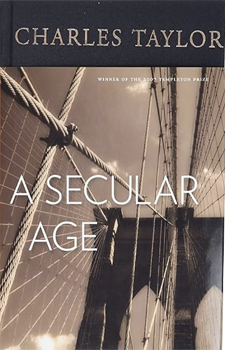
A Secular Age
by Charles Taylor
My last two books are the ones that have most shaped my thinking during the past decade, and each one represents the culminating magnum opus of a great scholar writing at the end of his long, honored career. Both have been crucial in my own quest to better understand our present moment in history through a deeper understanding of our history and of evolution itself. Taylor’s A Secular Age and Bellah’s Religion in Human Evolution are the best historical overviews we currently possess that successfully counter both kinds of “subtraction stories,” as Taylor calls them, that are so widespread in our time. The first kind is what Taylor particularly had in mind, the dominant secularist progressive view in modern academia that human beings only had to liberate themselves from the superstitions of religious belief and the earlier horizons of knowledge to enter properly into the real, objective world as modern rational-moral individuals. The second kind is what I would regard as a converse or mirror-image set of subtraction stories that are prevalent in our contemporary counterculture, the view that humanity has undergone an unqualified fall as a result of the rise of Western thought, or Christianity and monotheism, or some combination of European civilization, Axiality, modernity, modern philosophy, science, rationality, secularity, and so forth. The great challenge is to hold the tension of opposites between these two powerful outlooks, each with its own insights and blindspots, and to integrate them into a larger vision. I’ve described these two subtraction stories as different contemporary expressions of two archetypal orientations, the Myth of Progress and the Myth of the Fall, respectively. Taylor and Bellah have each provided us with monumental works that hold that tension, great historical overviews that are essential reading for all who wish to understand who we are as a civilization and as a species. As the historian Daniel Boorstin famously put it, “Trying to create the future without knowing the past is like trying to plant cut flowers.”
Charles Taylor is viewed by many as our greatest living philosopher. A Secular Age is the second of his two great works, the first being his equally essential Sources of the Self: The Making of the Modern Identity, which was published almost twenty years earlier, in 1989. Both are big books, and require attentive reading. But every sentence is clear, and each fits into its paragraph and its chapter and an overall vision in a coherent way. The books richly reward whatever level of concentration and thoughtfulness you bring to it. Taylor is a model for how to do scholarly writing for the intelligent general reader, in the warmth of his tone, the generosity of his spirit, the range of his scholarly reference, the careful nuance of his thinking and writing, the intellectual modesty he shows as he speaks to his reader. Each sentence is a building block that is creating a larger vision of human experience and how we live our lives. By the end, even by the end of the first chapter, there emerges a new take on human reality: a deeper vision, a more adequate ontology, an understanding that is satisfyingly rich and complex, but also dynamic, evolving, and shining light on many things.
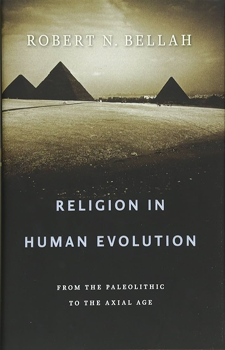
Religion in Human Evolution: From the Paleolithic to the Axial Age by Robert Bellah
Robert Bellah was widely regarded as the preeminent sociologist of religion in the second half of the twentieth century, and in his final fifteen years he became our preeminent historian of religion in the larger evolutionary context as well. He died a decade ago at age 86, just two years after completing Religion in Human Evolution, the work he had been hoping to write since he was in his late twenties, when the basic conception first emerged in his mind that would inform his final work. There are not many scholars who write a classic paper in their youth, in Bellah’s case an amazing essay called “Religious Evolution” delivered as a young co-instructor at a Harvard seminar in the early 1960s, and then wait a half-century until, after retirement, he could at last devote his final years to fill out the picture with all the scholarly detail he knew would be necessary to ground and elaborate his initial vision. In writing Religion in Human Evolution, Bellah is contributing to a vast civilizational task that is comparable to the psychotherapist’s task, helping the patient deal more successfully with whatever challenges that brought that person into analysis by gradually arriving at a new narrative that will redescribe the person’s life. It is the task of envisioning a new, more life-enhancing narrative, engendering it, imagining it, and recognizing it all at once.
But rather than working within the individual therapeutic context, Bellah is working at the larger and longer civilizational level, at the level of a great historical and evolutionary narrative. Bellah has given us so many extraordinary insights and important evidence in this book, page by page, chapter by chapter, that throw light on our human evolution and spiritual self-understanding. He begins with prehistory, going back to hominin evolution, indeed to the origin of the universe and of life, and then carries his narrative through the earliest tribal forms of human society, then the great archaic civilizations like ancient Egypt and Mesopotamia, culminating in the four major Axial cultures of ancient Israel, Greece, China, and India. There is continuity throughout this great survey, all the way back, recognizing that history and evolution cannot be separated. Underlying Bellah’s analysis is his deep insight that all of history lives within us, that the past is embedded in the present and thus in the future as well. We must bring this deep past to consciousness to know ourselves, and thus to create our future.
*****
As Nietzsche says, all of our teachers have at last come to a stop. This will be true of you and me as well. But other birds will fly farther. We’re all part of an immensely long collective journey that we can barely discern. We can only live fully within our small portion of that journey and strive to contribute to it. And then pass the torch.